

Auditable AI is table stakes for regulated industries. Your board, your regulators, and your customers all want the same thing: evidence that the numbers on the screen are trustworthy and that a human is still in charge. The Compliance dashboard shows you exactly where you stand against the ISO/IEC 42001 AI management standard, so you never walk into an audit guessing.
Open the Compliance tab
Open any command center and select the Compliance tab from the left-hand navigation. The tab is available to owners and admins by default, and you can grant external reviewers the Auditor role from the Permissions tab when you want them to see the same view you do.
The tab loads a single page focused on one question: how auditable is this command center? Everything on the page is computed live from the data already flowing through Delphi, so there is nothing to configure and nothing to schedule.
Trust Score metrics
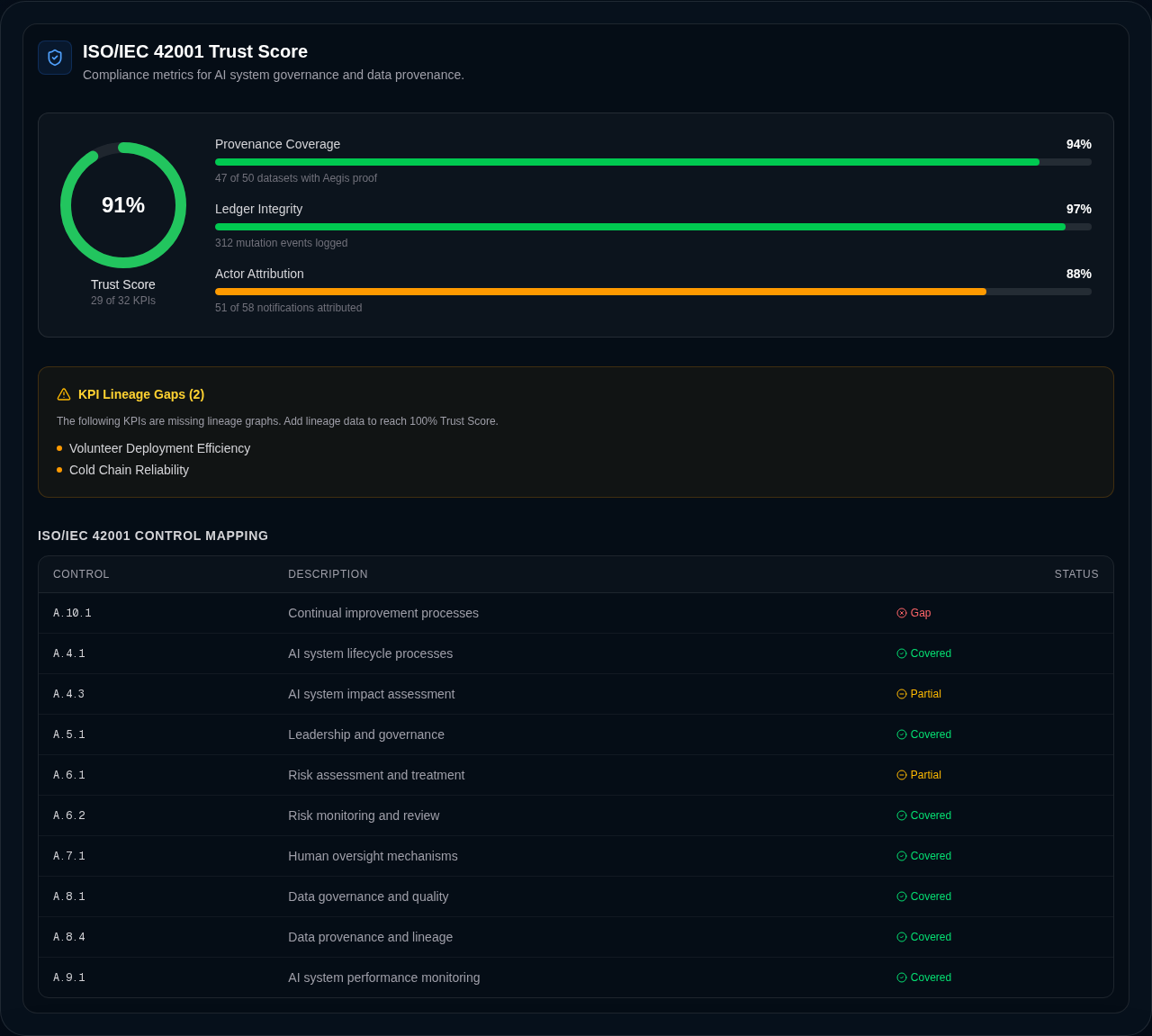
At the top of the page, your Trust Score appears as a percentage ring. The score reflects how complete your lineage coverage is across all artifact surfaces — KPIs, visualizations, and reports — so every headline number, chart, and briefing on your dashboard can be traced back to a source.
Three supporting gauges break down the score further. Lineage Coverage shows the share of artifacts with a complete provenance chain, aggregated across KPIs, visualizations, and reports. Every artifact’s lineage is represented the same way — sources, transformations, and the artifact they produced — and a small provenance indicator on each card shows the state at a glance: green for a complete chain (sources, transformation, and artifact all present), yellow for partial (source only, no transformation record), and red for missing. Ledger Integrity reports how many mutation events have been captured in the tamper-evident ledger. Actor Attribution shows the share of notifications and alerts that can be linked back to a named human or agent actor.
A provenance proof, in this context, is a cryptographic integrity record attached to a dataset snapshot — a hash chain over the underlying observations — so that anyone looking at a number later can confirm the data wasn’t altered between collection and presentation. Provenance Coverage is the share of datasets that carry one. You don’t need to read the proofs themselves to benefit from them; their presence is what lets the trust score climb, and their absence is what the gauge surfaces as a gap to close.
If any artifacts are missing lineage, Delphi lists them in a Lineage Gaps callout directly below the Trust Score — broken out by KPIs, visualizations, and reports. Each gap is a concrete next action. Fix the gaps and your score climbs.
ISO 42001 control mapping
Further down the page, Delphi maps the live state of your command center against ten controls from ISO/IEC 42001, the international AI management standard. Covered controls include AI system lifecycle processes, impact assessment, leadership and governance, risk assessment and treatment, risk monitoring, human oversight mechanisms, data governance and quality, data provenance and lineage, performance monitoring, and continual improvement.
Each control is labelled covered, partial, or gap based on the same signals that drive the Trust Score. Partial and gap rows tell you where to focus next. Covered rows give you something concrete to point at when a reviewer asks how a given control is satisfied in practice.
Showing it to auditors
When an audit comes around, invite your reviewer to the command center as an auditor. The auditor role is read-only, scoped to the dashboards you explicitly share, and designed for exactly this situation.
From there, walk the auditor through the Compliance tab first, then the Audit tab so they can see the underlying ledger events that back every metric. The Compliance tab is the executive summary. The Audit tab is the receipts. Together they let you answer almost any “show me the evidence” question in minutes rather than weeks.
Delphi does not issue ISO 42001 certifications, and the dashboard is not a substitute for a formal audit. What it does do is give you and your auditors a shared, live view of the signals a certifying body will ask about, so you walk into the conversation prepared.